
Lingchi (凌遲)
A Tale of Magical Realism

Lingchi (凌遲)
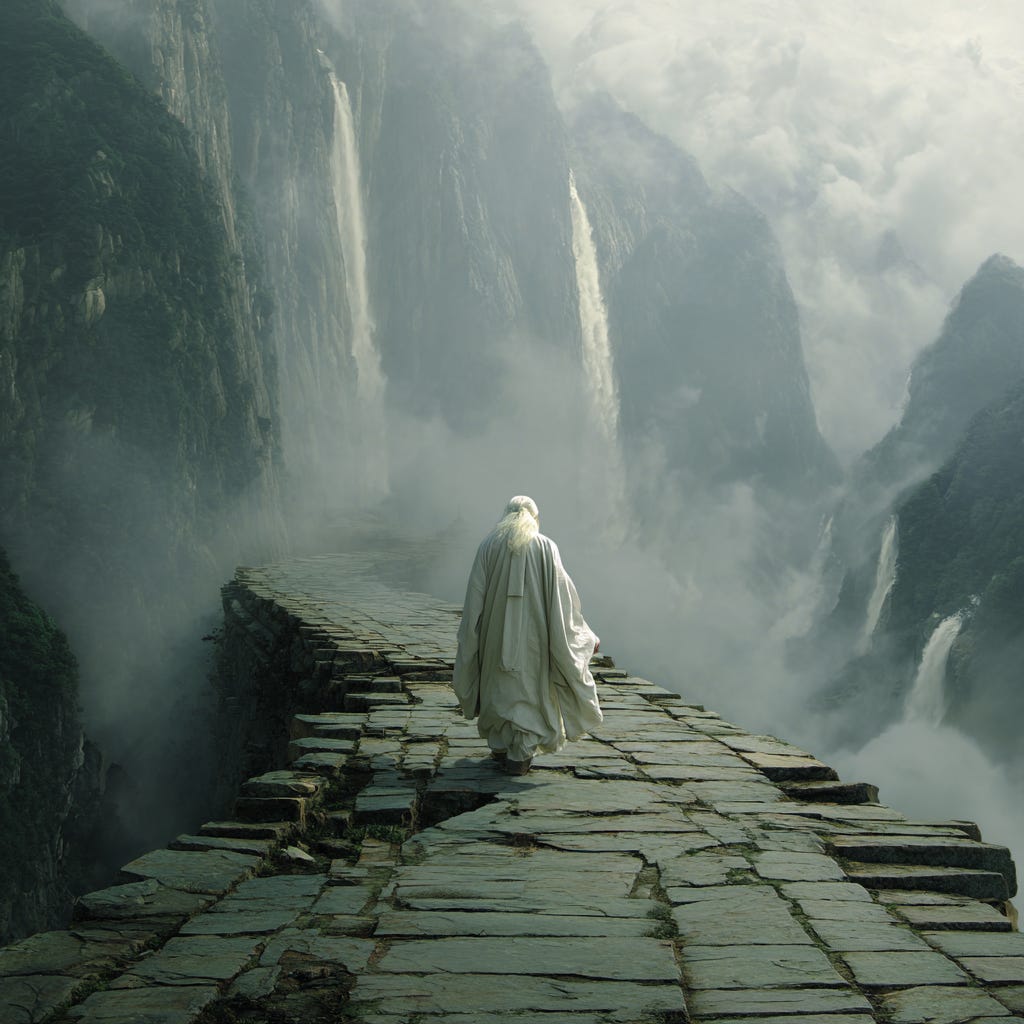
The white-robed man passed wraithlike through the pillar gate as quiet as the first drops of spring rain. The ancient’s progress disturbed neither the dust he trod nor the half-dozen sentries scowling into the mist out of which he emerged. Decades of conditioning had transformed the guardians into mute statues sapped of vitality and those passions that feed the optimism of youth. Obedient to a duty never fully explained to them, they stood, knowing only that, if they did not respond to certain nebulous threats the old man was obviously not representative of, their lives would be as forfeit as his whom they guarded.
And so warding off sleep, the lorn warders waited; and their brows and dagger-axes glistened with the dews of the morning.
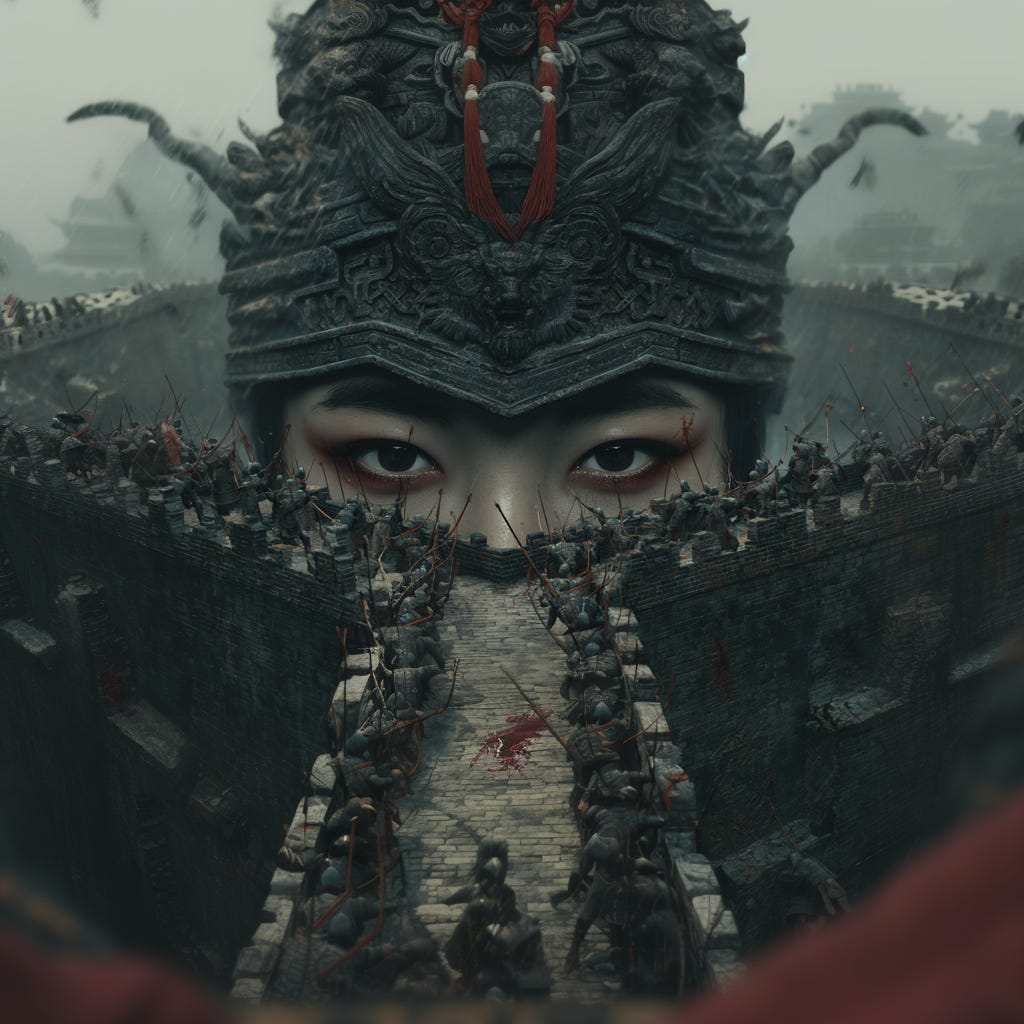
The perimeter of the prison-house comprehended a terrain vaster than the land lorded over by the fabled Duke of Zhou. Millions of men in brigandine armor patrolled its crazy roads and shadowed purlieus night and day. The armies bivouacked in the owl-haunted towers or loitered in close-knit arrays on the crumbling battlements, which the unremitting eons had furred with a scurf of thick moss. Every structure of the complex was cracked and riven where vines had invaded the narrow fissures and pried them apart into yawning gaps.
Some said the ruin was as old as the world and had served as the seat of the immortal Shen whose eyes first contemplated in their far-ranging glimpses the limits of Heaven and Earth. Others claimed the Yellow Emperor built it as a fort and pointed to architectural evidences indicating its former usage as such. For in the interlocking chambers were corridors filled with armor whose sharkskin and leather flaps, decayed to a black pulp, were crowned with bronze helms now white-green with verdigris. Pornographic murals suggested its pigsties had once been barracks or brothels or both.
The daily assaults waged against the prison’s outer defenses, transpired in districts so far-flung and remote that soldiers living miles away (with their wives, concubines, and bastards) presumed the smoke they witnessed rising in the distance was not due to military engagements, but were celebrations, weddings—festivities that had been arranged to commemorate matters of great consequence that the denizens of that district had determined warranted many weeks to fully and appropriately officiate.
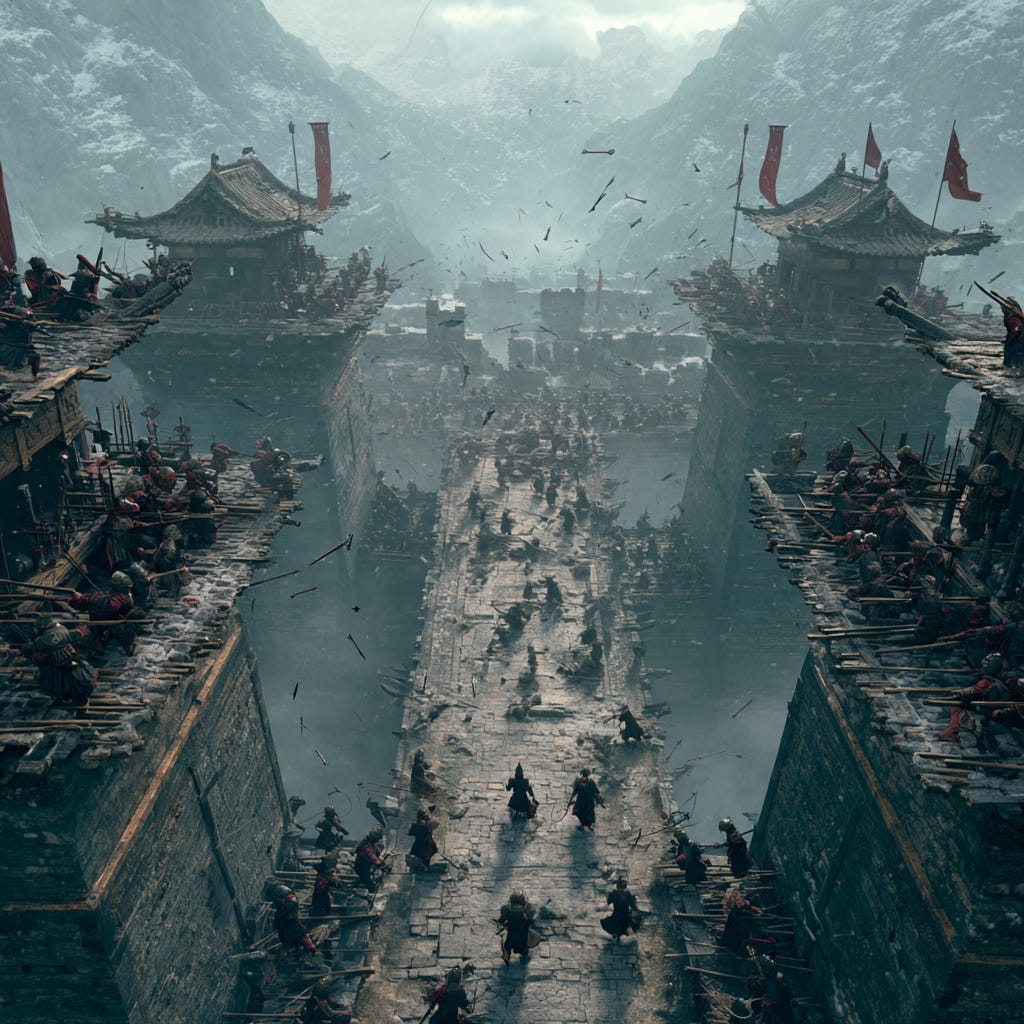
The peace and tranquility of those who inhabited the hollow spaces within the prison’s walls was routinely shattered by siege engines and massive wheeled towers that approached in order to commit mischief and great slaughter. Untold numbers fell on either side when such battles occurred. The sky became a canopy of crossbow bolts and arrows. But the armies of the prison always prevailed. And when this happened, the extinct war machines, still clinging to the walls became part of it, affording new places refuge and recreation for the soldiers and their kin, who had been taught since childhood that to live was to be in a state of perpetual war; and that war was nothing but a game.
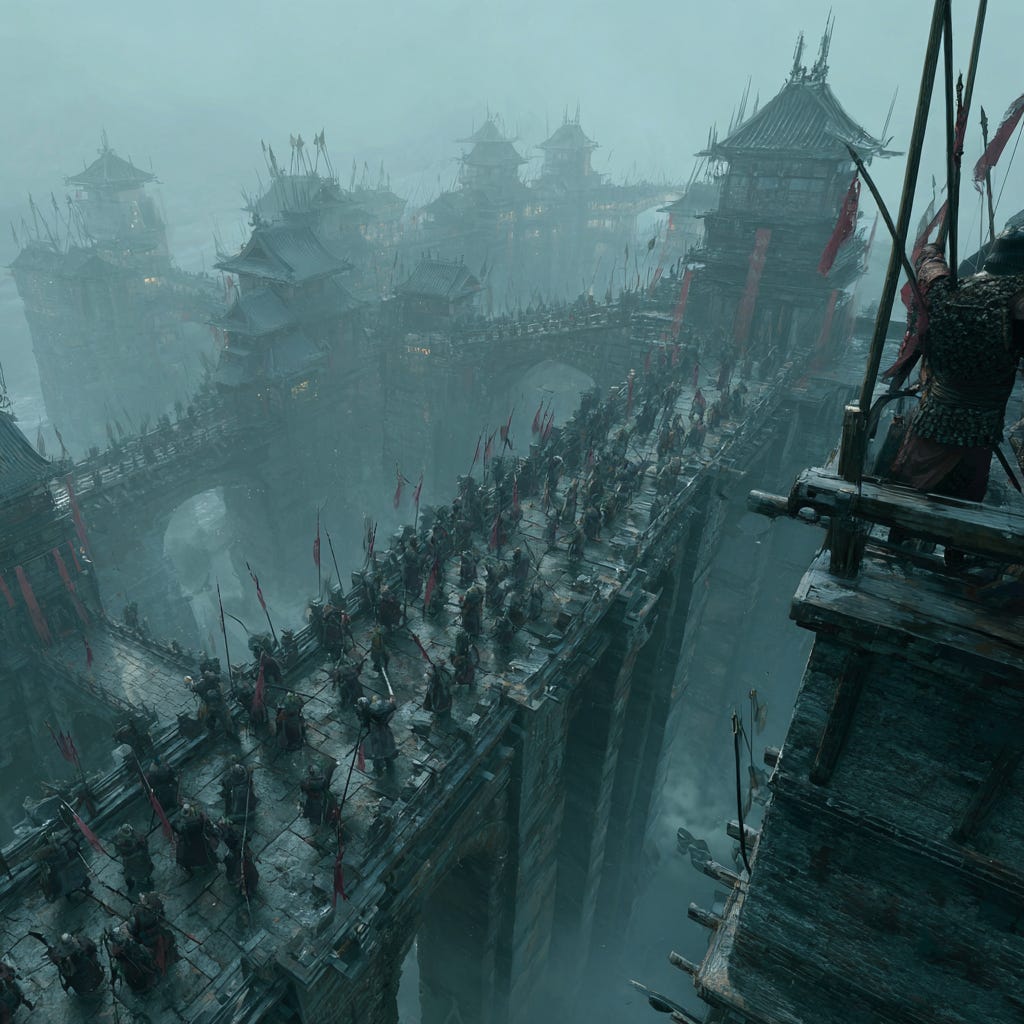
Jia Lin’s vestments and white beard skirled in the wanton breezes blowing from the mountaintops, sweeping over the arched bridges spanning gorges whose verging cliffs were heaped with the kite-plucked bones of ill-fated warriors who had risked all to liberate the venerable prisoner whose name none could recall.
Ying Zheng’s unbroken successes on the battlefield had distinguished him as the greatest tactician ever to have lived. But with power came pride; and the feuding factions in the House of Wu, whose varied causes Ying Zheng had championed for one hundred years, culminated in a spectacular downfall that required another century for his memory to be wiped from the annals of the Middle Kingdom. From the moment of the hero’s capture, it was the Chief Eunuch, Jia Lin, who was charged to implement what all agreed was a condign punishment that was to precede an execution set for a date the long-dead sovereign of the House of Wu had granted Jia Lin the exclusive privilege of determining.
Each day the eunuch journeyed many hours through a labyrinth of galleries, corridors, bridges, stairs, and alleyways hedged in with toppling ruins in his pursuit of a course so secret that only he was allowed to know it and survive. The executioner was one year older than the man whose life hung in his balance and had protracted until necessity should dictate that it come to an end. Not a single nobleman of the Warring States questioned the justness and sanctity of Jia Lin’s mandate.
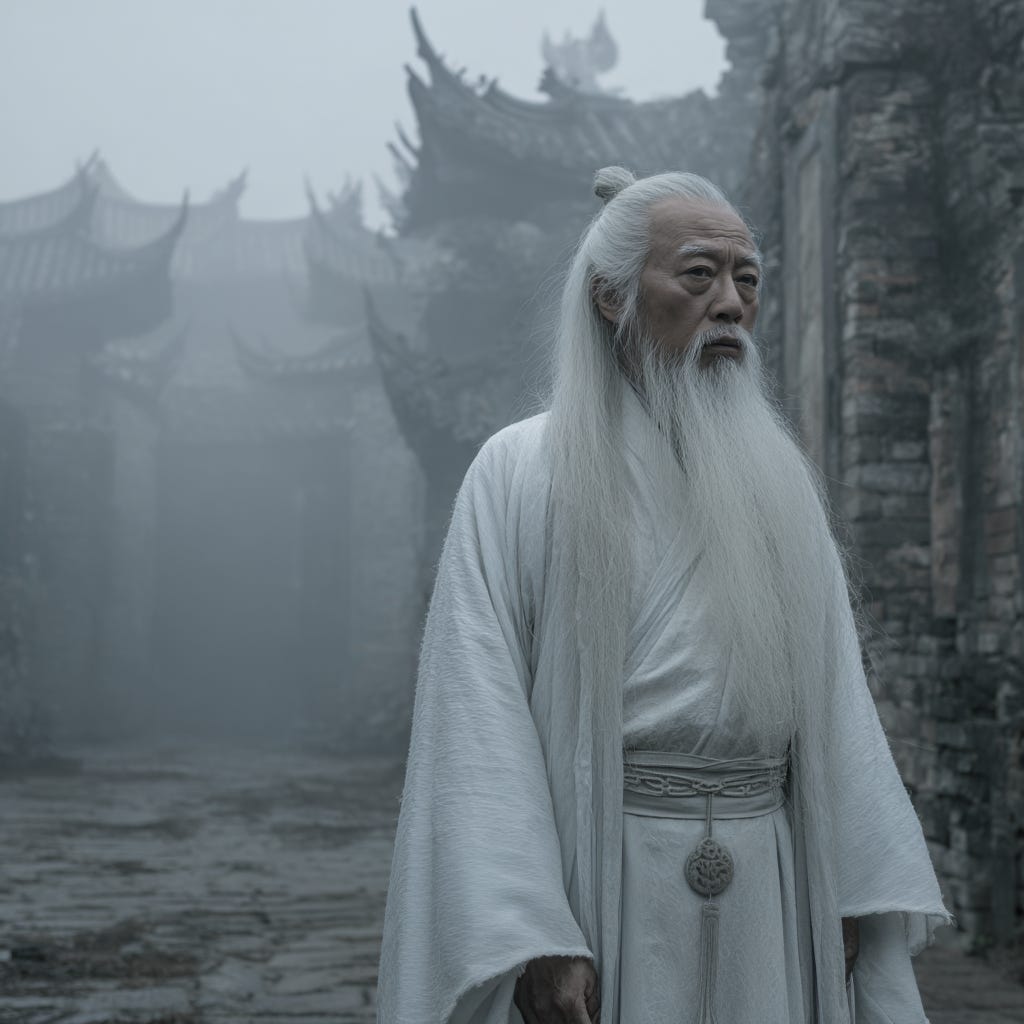
The eunuch ascended a grassy bluff crowned by the gorgeous apartments of the palatial siheyuan whose slender red pillars supported many hanging hill rooftops. The attendants who ministered to the prisoner’s needs (though forbidden to speak to him) withdrew timorously at the eunuch’s approach, as they always did.
Jia Lin was certain the sun’s rays would not penetrate the drooping clouds on this day. The apartments’ inner apartments were illumined with candles and beneath the flaring eaves without swung countless tasseled lanterns. Crossing the parade ground Jia Lin mounted the stone staircase opposite and espied through a wide open door a crippled shadow unbend against the gray-brick wall within. The joss sticks burning upright in the sands signified that, though the prisoner was yet alive, he was not accounted among the living.
A wheezy voice broke the silence. “I expected you earlier.”
Jia Lin nodded. “My thoughts were lost in a reverie of anticipation that retarded my arrival. Today is a momentous one.”
Lingchi, which is to say “the lingering death,” was a sacred punishment whose origins the mandarins of later ages would trace to the refined and poetic disciplinarians of the Tang dynasty. But as the gibbering wuxian who infest the Yangtze’s bordering marshes are fond of saying: “All things that are beautiful and righteous in this world existed—stark and naked—long before men clad them in the interchangeable garments of words.”
Each day, the condemned was wounded, maimed, or disfigured in some way. During the first decades of his confinement, this took the form of slight and comically inconsequential incisions, nicks and cuts smaller in length and breadth than the wing of a fly. Every part of Ying Zheng’s body—to include the genitals—was become a network of scars, which were periodically opened again to produce a fresh effusion of blood.
On the twentieth-fifth anniversary of their association, Jia Lin hacked off Ying Zheng’s left foot with a single blow from an ornate hatchet forged solely for this purpose. The eunuch cauterized the stump, and Ying Zheng fainted away. For three days, Jia Lin knelt beside the pallet nursing the swooning patient to health. When at last his friend’s eyes fluttered open, the executioner stated that he must administer three wounds for each day Ying Zheng had slept. With a slight inclination of his head, the prisoner allowed the keen blade of a knife to slice two times his eyebrows before the third wound, a puncture, blinded him permanently in his left eye. Old age had all but extinguished the vision of his right eye.
On this special day, each man took his seat opposite the other with a lacquered weichi board between them. By custom each visit commenced with Ying Zheng placing a single black stone on the board. Before departing, Jia Lin would attempt to counter the maneuver with a white stone that he set upon another of the 321 intersections of the weichi grid. Over the course of the 36,524 days of the general’s captivity, Jia Lin had lost every one of the 175 iterations of the game. But his continual defeat in no way diminished the enjoyment both derived from this pastime. Jia Lin studied the board to re-familiarize himself with the layout as it had been before yesterday’s departure. “It is your move,” the eunuch said.
“As it has always been.” The prisoner sighed. Ying Zheng placed a stone on an intersection that Jia Lin could not have predicted had he lived two thousand lifetimes. The move was called a mang-shou, a “blind move,” and when Jia Lin realized that Ying Zheng had executed it as a way of mocking his own near blindness while simultaneously guaranteeing victory, he could not resist a hearty laugh.
“As I have told you before,” Ying Zheng purred, “I never let my enemy know where I will attack. This forces him to spread his armies thin, so that when I make the final sally the enemy is spread thin and the point of engagement is insufficiently defended.”
“I have preserved all of your dicta concerning the rules of war, which, throughout the decades, I have displayed anonymously in all the public spaces on bamboo strips. But I know, as I’m sure you do, that your followers have intuited where all of these statements come from.”
Ying Zheng’s dim eye twinkled. “They know me only as The General.”
“And your followers have tried to rescue you on many occasions. But all of their attempts have failed. Why do you think that is?”
The prisoner shrugged and glanced at his crutch. “They have failed because you have used my advice against me. You know what they know; and you have thwarted their inept designs. You may not be a strategist, as your abysmal performance in weichi demonstrates.” He gestured with a fractured wrist at the weichi board. “But you are a master of deception, a quality typical of your . . . kind.” He plucked two gooseberries from a bowl and cast them jauntily over his shoulder by way of mocking the eunuch.
Jia Lin smirked. “Have you not said that all war is based on deception?”
“Indeed, I have.”
“Before your fall, you advised the King of Wu to have me butchered and my dismembered pieces burned. Why is that?”
“Because you are my mirror image. It is indecent that one as low-born as you should resemble one as great as I. It is as if you are my baser half.”
Jia Lin’s eyebrows lifted. “It is for this reason that I was chosen to be your executioner. We were born of the same mother. But my father was not a nobleman, like yours. I was raised among the abject washerwomen of the House of Wu. Gelded as a child, I have served many lords. But our mother is of a greater bloodline even than yours. She was the daughter of the warrior goddess, Jiutian Xuannü. Her name was Sun.”
“Sun? I don’t recognize the name. I never knew her.”
“It was her duty to raise me. But it was you alone whom she adored. I have compiled into thirteen chapters those heaven-sent laws of war that you have narrated to me. But it is her name that shall be affixed to this treatise, which shall serve warriors for millennia to come. Posterity will know the author as Sun Tzu—Master Sun.”
Ying Zheng lowered his eyes. “And so my memory will be forever forgotten.”
“On the contrary, you, I, and the goddess who bore us, shall be remembered long after we are dead.”
“There is no honor in a victory shared.”
“There is no other. We have always been one and the same.”
Jia Lin placed a dagger on the gaming table. Both he and Ying Zheng pondered wistfully the magic etchings on its blade.
“When I was a child,” Ying Zheng said, “a soothsayer interpreted the oracle bones that I cast. These same words appeared upon them: You are destined to destroy yourself.”
“You are my brother,” the eunuch said. “We are of a single soul. I am the Po, which is to say the gross and baser half of your spirit. You are the Hun, that which is good, subtle, and everlasting. I am the slag and dross that shall remain enchained to your rotting corpse when we are dead. But you shall ascend to the heavens to take your seat with our mother. And so, with this final cut, your immortality is secured.”
Jia Lin seized the dagger and slit his throat, drenching the weichi board in a spray of blood. Ying Zheng cried in agony as the body of his executioner fell forward, scattering the pieces to the floor. The servants of the siheyuan had grown accustomed to such cries over the years. And so they went about their daily chores, oblivious to the drama unfolding in the opulent cell they were forbidden from entering on pain of death.
A peel of thunder accompanied a booming sexless voice, which filled the thickening cloudbanks overhead.
An army is as water, which falls from great heights and rushes to the lowlands. For like a river’s current, an army avoids the strong and the steadfast, overwhelming the weak and unstable in its tumultuous advance.
The rain fell in torrents, as the waters rose between the banks of the rivers that came down from the mountains. Like beads of rain dripping down a slender string, men rappelled down the cliffs on flaxen ropes. From their places of concealment in the caverns overlooking the prison’s walls, armored men waded through the currents that flowed to craggy brinks and descended in slender waterfalls to the valleys far below. The floods meandered, diverging through many mazy channels, some of which irrigated the prison’s gardens and filled the cisterns that sustained those within.
As water is shapeless, war too has no form.
Every window and portal in the prison’s ruined tower were thronged with a surging tide of warriors pouring through the streets. Red banners fluttered and snapped and were adorned with the stylized characters of him whom the assailants knew only as The General.
The ground beneath the prison had become a warren of tunnels burrowed out of the living rock over a period of many years to serve as access points for this premeditated infiltration. The guards at the pillar gate abandoned their post and vanished into the fray. They were so exhilarated by what they now recognized to be the obligation they had waited entire lives to fulfill that they ignored the white-robed man, who passed wraithlike through the pillar gate, as quiet as the first drops of spring rain. The ancient vanished into the curtaining mist from which he had emerged in the first light of dawn.
A bold move to build such a tale on the most well known, and some would say worshiped, tome dedicated to war as art! Impressive with mystery unanswered as would be appropriate.